GETTING READY TO MOVE
ON THIS PAGE: GET TO KNOW TL | VISAS | GETTING TO DILI | WHAT TO BRING
Congratulations, you’re moving to a tropical island! Well, hold on, maybe you haven’t made up your mind yet? Or, perhaps you’ve already arrived in Dili. Either way, we hope this intro to life in Southeast Asia’s newest country is helpful. Check out the Travel Inspired channel for a look at everyday life in Dili, and read on!
GET TO KNOW TIMOR LESTE
Population: Around 1.3 million
Population of Dili: Around 230,000
Languages: Tetum, Portuguese (legal), some Bahasa Indonesia and English, variety of local languages
Religion: 97% Roman Catholic
Colonizers: Portugal and Indonesia
Much of the international narrative about Timor Leste involves its journey to independence. When Portugal started divesting colonies worldwide after 1974’s Carnation Revolution, Timor Leste became its own country for about a hot week until Indonesia invaded. An internal resistance movement began and continued for decades, finally gaining sustained international attention in the 1990s. A UN-led referendum resulted in Timor Leste becoming a fully independent nation in 2002.
Timor’s relative geographical and political isolation, along with its turbulent history, means it is still developing its economy and finding its place in the world. Revered resistance leaders such as Jose Ramos Horta and Xanana Gusmao dominate politics even today, while a new generation seeks opportunities inside and outside the country. Oil and gas profits, which have sustained the economy for years, face an uncertain future.
In a small nation of just over a million people, interconnectedness is the norm, and community is emphasized over the individual. Family relationships and local networks are of high importance for Timorese, personally and professionally. Many young people come to Dili for opportunities but remain connected to their home place in “the districts.” It’s normal for the capital city to empty out at major holidays, as people travel – often by motorbike – back to their family homes.
For international connections, neighboring Australia is important. Timor Leste’s independence was a cause célèbre for a generation of Australian students in the 1990s. Australian foreign interests are often entwined with Timor’s – sometimes graciously, sometimes combatively.
The Dili establishment chose to keep up good relationships with former colonizers Indonesia and Portugal, a seemingly counterintuitive move that has brought friendship with and resources from those more-developed nations. Timor Leste’s law is still in Portuguese, supporting a network of expat legal advisers with deep roots in the country.
China’s influence looms large, with Pacific islands like Timor becoming a proxy ideological battleground between China and Western countries. Dili hosts a large Chinese business community. Asian nations like Korea, Malaysia, and Japan maintain embassies in Dili and are an important international link. Timor Leste is lobbying seriously for ASEAN membership.
Understanding Timor Leste’s history can help observers decipher its present. Many of the recommended sights in Dili center around the proud history of resistance and independence. If you want to start learning before you get here, try these:
- The movie Balibo: Directed by an Australian filmmaker, this 2009 international feature film tells the story of five Australian journalists killed in Timor Leste in 1975 by Indonesian forces.
- The book Beloved Land: International writer Gorden Peake chronicles his post-independence connections to Timor Leste in this 2013 memoir, with lots of insight into history and culture.
- Short documentary “This is Reality“: This 2023 Al Jazeera Witness feature is about Timorese actor Osme Gonsalves and his alter ego, social media quest to define the future of his country.
VISAS
Almost everyone will need a visa to enter Timor Leste. Ninety-day, on-arrival tourist visas are generally available at Dili’s airport (be sure to have the proper amount of US cash with you). Land entry is trickier. Longer stays depend on organizational connections; anticipate numerous hoops to jump through, in a process that might not always be straightforward.
Things can change quickly and without much notice, so this is just about all that Dili Guide is going to say on this topic. Check Timor Leste’s immigration website, and rely on your in-country contacts for advice.
GETTING TO DILI
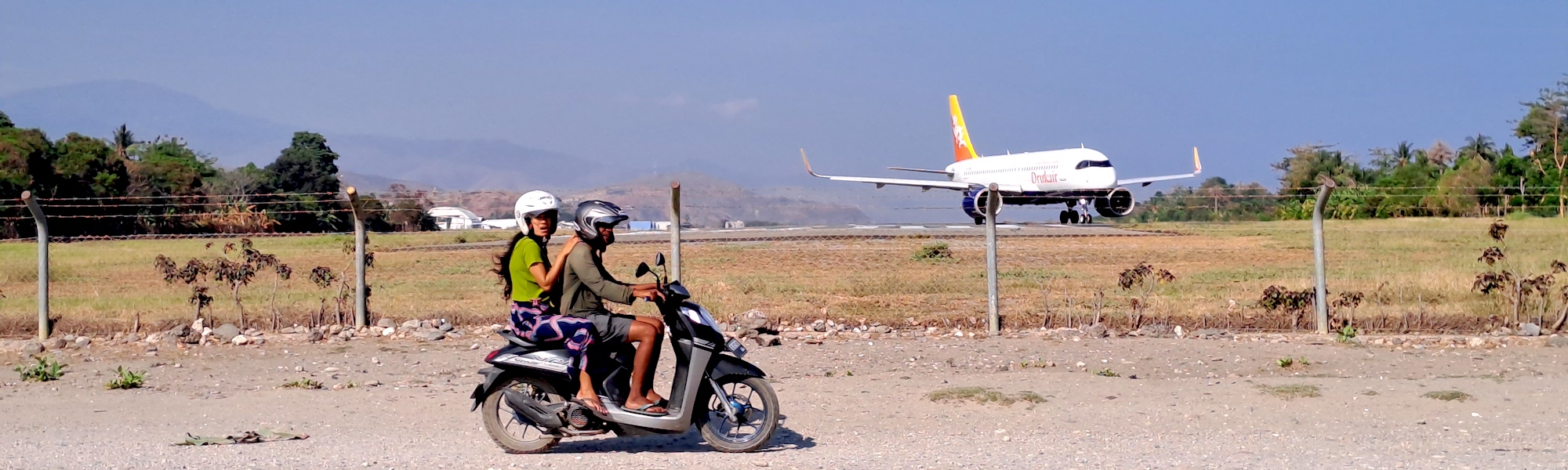
Did you know Dili’s international airport doesn’t have runway lights? That’s right, no airplanes can land between dusk and dawn. From this you can deduce: Timor Leste is a small travel market. To make things more complicated, closure of borders during COVID stopped international travel almost completely, and some travel routes have been slow to recover.
That said, there are daily routes into and out of Dili. Most flights connect through Australia, Indonesia, or a rotating collection of Southeast Asia capitals. Don’t expect bargains. If you are coming from the opposite side of the globe, door to door travel time can approach 48 hours.
When international flights came back after COVID, many routes were run as charters – some might still not be bookable online or by outside travel agents. If you are coming to Timor Leste for work, rely on the advice of whomever in Dili is helping you plan your trip. It might be necessary, or cheaper, to have someone buy the Timor Leste portion of your ticket in Dili.
Unless you are coming in on Qantas from Darwin, it’s likely your journey will be on multiple airlines with separate tickets. This means you might have to collect and re-check your bags and/or do a separate check-in for boarding passes in a connecting city – allow enough transit time for this. Be sure you can legally pass immigration in the connecting country, if you have a non-contiguous ticket and are required to do so.
Arriving from Australia: Qantas runs regular, daily flights from Darwin, the main city of what Aussies sometimes call the Top End. Air North typically also connects Darwin and Dili a few days a week. Flights are about an hour and a half long. Darwin is not a huge airport, so using this route to get in or out of Dili to/from somewhere outside Australia will probably mean connecting through Sydney or another Australian hub. A long layover somewhere in Australia is likely.
Arriving from Indonesia: Pretty much all flights from Indonesia to Dili come through Denpasar. Never heard of Denpasar? It’s Bali, silly! As of late 2023, Citilink (Indonesian airline) and Aero Dili are the main players here, and you should be able to find a Denpasar-Dili flight pretty much any day of the week. A long layover in Bali is likely. But hey, that’s not a bad thing, maybe? Many expats add an out-of-airport adventure in Bali, going in or out of Timor Leste, to chill and explore.
Flying in from somewhere else: Singapore and Kuala Lumpur are sometimes featured in irregular connecting flights, though routes can be dropped and added with little notice. Occasionally, due to the large Portuguese community in Dili, there’s a flight on an airline run by the former colonizer.
Arriving by land: Possible, via the land border with Indonesian West Timor. You’ll need to sort out visas and entry particulars ahead of time. Indonesian airlines offer flights to Kupang, at the western tip of Timor island. Kupang-Dili buses make daily runs.
Arriving by sea: Infrequent, except on irregular cruises.

WHAT TO BRING
As a developing island nation that has to import just about everything except coffee and coconuts and coral reefs, availability of certain consumer goods can be limited. But don’t panic, food stores are everywhere, and anything you really need you can usually find – with patience.
If you are bringing in a shipping container of household goods, be aware that this will be expensive, and the process may have some challenges along the way. Timor Leste does have a new and well-operating port, however, and container delivery generally works as needed.
Please keep in mind that you are coming to a climate- and waste-challenged island with amazing natural resources slowly being polluted by modern practices. So a “pack it in, pack it out” mentality is recommended. Most lodging aimed at expats is furnished, so think hard about what you really need to bring with you.
That said, here are a few notes for your packing.
Things you might want to bring:
- Medicines and medications: These can be hard to find in Dili, so if there are particular health items essential for your wellbeing (including vitamins/supplements), bring in enough to last you however long you need
- Skin / cosmetic products: If you can’t live without a certain kind or brand, bring some with you
- Reef-safe sunscreen: Supply in Dili can be irregular
- Adequate clothes and shoes for your whole time here: Availability of Western-quality apparel and footwear is increasing, but many expats still buy wearables outside the country
- Small electronics like cameras and watches: These can be hard to find in Dili (large electronics and decent low-to-mid-grade mobile phones are generally available)
- Reusable shopping bags and biodegradable waste/storage bags
- Specialized recreation equipment
- Swimwear
- Printed leisure-read books (if you can’t stand e-readers)
- An openness to adventure and appetite for adaptation
Things NOT to bring:
- Bottled coconut water: You can find fresh green coconuts just about everywhere!
- Bulk single-use plastics: Timor has enough bottles and bags washing up on its shores already
- Nespresso/Keurig or similar coffee makers that use plastic cups (see above)
- An inflexible, demanding, must-have-all-my-developed-world-comforts attitude
Good luck getting yourself and your things into the country, we hope you arrive and thrive!
 Dili Guide